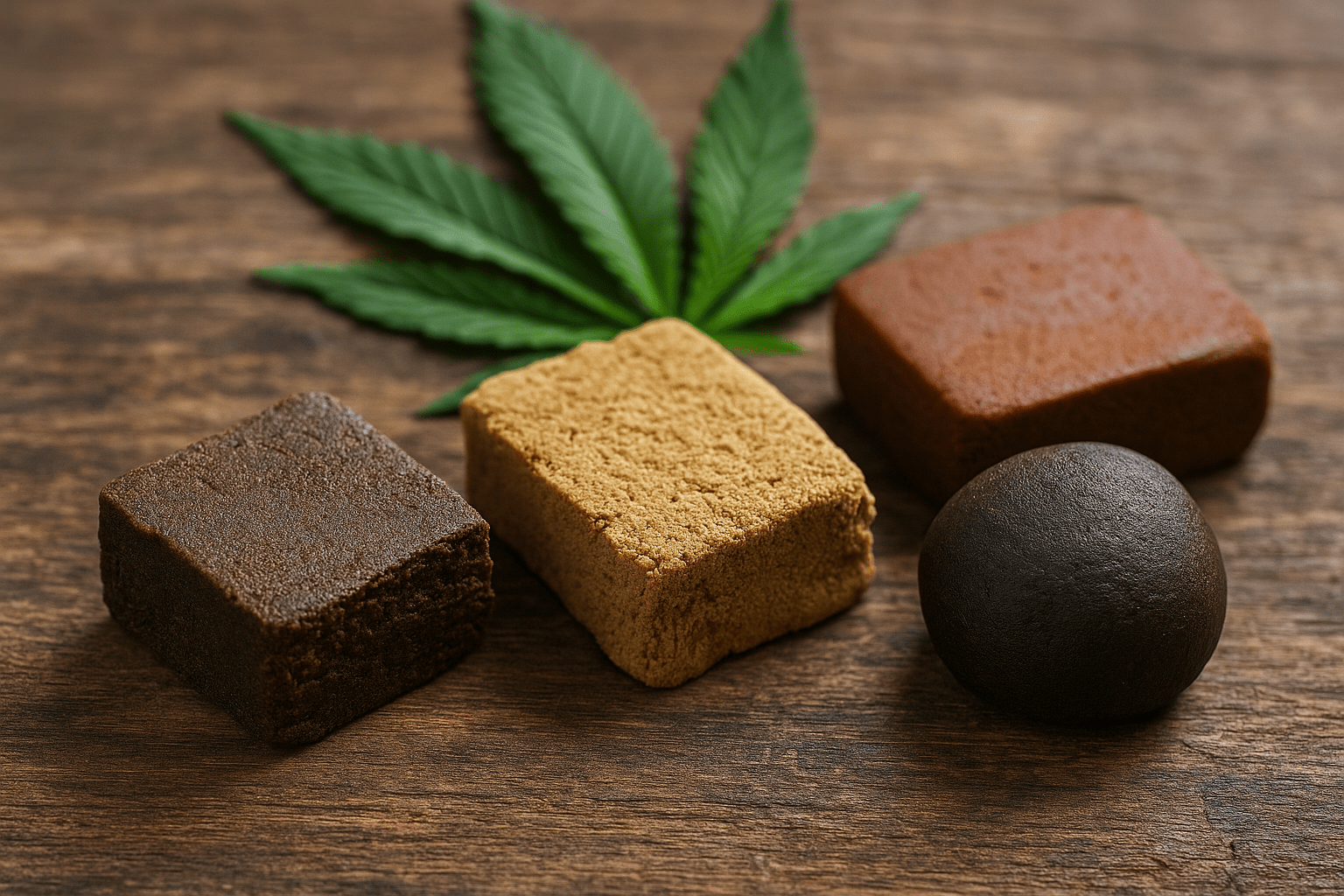
Particle Size < 160 µm: Impact on the Purity of CBD Hash
Introduction
CBD Hash, also known as cannabidiol hashish, is a hemp-derived product rich in CBD and low in THC. In Switzerland, legislation permits the distribution of certain hemp-based products as long as their total THC content stays below 1% (a threshold set in annex 1 of OTStup-DFI, RS 812.121.11). This regulation, unique to the Confederation, has allowed the emergence of a legal market for CBD products, including various forms of hash made from hemp resin.
One key quality criterion for hash is its particle size, which refers to the microscopic scale of the particles. It is sometimes said that sieving at less than 160 µm results in a purer and more homogeneous product. But what is the reality, and where does this 160 µm figure come from? This article aims to clarify the role of particle size in the purity of CBD Hash, based on verified data and Swiss legislation.
What is Particle Size?
Particle size is the measurement of the size of particles in a given material. In the context of hemp and hash, it involves measuring the diameter of resin glands, plant fragments, and any other solid components resulting from the extraction or sieving process. Several tools can assess this particle size:
- Standardized sieves: These have meshes of different sizes (100 µm, 160 µm, 200 µm, etc.).
- More sophisticated instruments: Laser analyzers or electron microscopy.
In the production of CBD Hash, much of the technique relies on separating the resin (which contains cannabinoids, terpenes, and other active molecules) from the raw plant materials (leaves, stems, chlorophyll). Reducing the size of the particles in the final product theoretically increases the proportion of resin relative to the rest of the dry matter.
Standard Particle Size in Traditional Hashish
In traditional hashish, sieving is often done using more or less tight fabrics (e.g., 180 µm, 150 µm, 120 µm…) to separate the resin glands from coarser particles. Producers adjust the mesh according to the type of hemp used, the maturity stage of the plant, and the desired outcome of the final product. The actual size of the glands, however, depends far less on craft than on the plant itself, and this is where most articles on the subject go wrong.
Why 160 µm? What the Published Measurements Say
The 160 µm figure is almost always presented as though it matched the size of the resin glands. The published measurements do not support this, and the gap is substantial.
The reference study on this question measured the head diameter of capitate-stalked glandular trichomes under a microscope, explicitly comparing high-THC strains with industrial hemp cultivars 1. The protocol is spelled out: measurement at 100× magnification, 100 glands per sample, and crucially the measurement of every gland present in randomly selected visual fields, precisely to avoid the bias of recording only the largest ones.
| Material measured | Mean gland head diameter |
|---|---|
| Seven industrial hemp cultivars, living plants | 80 µm (per-cultivar means: 76 to 84 µm) |
| Industrial hemp, largest gland observed | below 120 µm |
| Ten high-THC strains | 129 µm |
The mean resin head volume of the narcotic strains came out more than four times larger than that of the industrial hemp cultivars 1.
Two direct consequences for Swiss CBD Hash, which is by definition made from hemp containing less than 1% THC 2:
- The “120 to 140 µm” range quoted everywhere belongs to narcotic strains, not to hemp. Applied to CBD, it overstates the real gland size by nearly a factor of two.
- Sieving is done on dried material, and gland heads shrink as they dry: 13.7% loss in diameter after 25 days at ambient room conditions, 24.5% after a year 1. An 80 µm hemp gland at harvest therefore measures roughly 65 to 70 µm by the time it reaches the screen.
Put plainly, a 160 µm mesh is about twice the diameter of a dried hemp gland head. It does not select trichomes: it lets all of them through, along with every piece of plant material finer than 160 µm. It is a first coarse-separation stage, not a purity criterion.
So Where Does the Selectivity Come From?
The useful separation happens below 160 µm. In dry sifting as in ice water extraction, the most sought-after fractions are collected on the fine screens, typically between 70 and 120 µm: wide enough to pass gland heads, tight enough to hold back stalks and plant fragments. This range reflects producer practice rather than any published standard, but it is at least consistent with the diameters actually measured, which the 160 µm figure is not.
Legal Framework in Switzerland: Essential Reminder
In Switzerland, the legislation around hemp and derived products is based on the principle of a total THC content below 1% for so-called “legal” cannabis varieties, a threshold set in annex 1 of OTStup-DFI (RS 812.121.11) and not in OCStup. CBD-rich products can circulate in the market, whether in the form of flowers, oils, creams, or resin (hash). However, certain elements must be considered:
- Product traceability: CBD Hash producers must be able to justify the variety of hemp used, ensure pesticide control, and guarantee a THC level below the legal limit.
- Consumer safety: Laboratory analyses are required to check for the presence of heavy metals, residual solvents (in the case of chemically extracted Hash), and microbiological contaminants.
- Labeling: It must clearly indicate the CBD and THC content and comply with legal marketing standards.
Regarding particle size, no legal provision in Swiss regulations explicitly imposes a maximum or minimum particle size for CBD Hash. However, analysis laboratories and producers rely on internal quality standards, often inherited from the traditional sieving of hashish, adapted to the Swiss market reality and validated by laboratory analyses.
Impact of Particle Size on Purity
1. Reduction of Undesirable Plant Materials
The finer the production sieve, the fewer fragments of leaves, stems, or undesirable elements are found in the final product. Larger particles end up diluting the proportion of active resin. The reasoning is sound, but it has to be followed through: since dried hemp gland heads sit around 65 to 70 µm, the gain in concentration mostly occurs once you go well below 160 µm. Moving from 200 µm to 160 µm removes coarse debris; moving from 160 µm to 90 µm is what actually separates resin from the rest.
2. Better Control of External Contaminants
Sieving at 160 µm acts as a filter to capture certain non-resinous impurities:
- External pollens.
- Insect debris.
- High dust levels.
However, it is important to note that this control does not necessarily prevent chemical residues such as pesticides or solvents. Only laboratory analyses can confirm the absence of chemical contaminants. But fine sieving can help reduce any solid micro-particles present.
3. Increase in Cannabinoid Content
By more finely separating the resin glands from the rest of the material, the relative share of cannabinoids and terpenes is increased. This results in a more concentrated final product in CBD, thus more appealing to users seeking a relaxing effect, without a pronounced psychoactive effect (as THC remains low).
The status of this claim should be stated clearly, however. The link between sieving fineness and cannabinoid content follows directly from what is being separated, resin on one side and plant material on the other, and it can be verified product by product on a certificate of analysis. But to our knowledge there is no published study comparing sieve fractions of Swiss CBD hemp and quantifying the difference in content between them. Any announcement of a precise gain, expressed in percentage points, comes from a producer’s internal data rather than from the literature.
4. Homogeneity and General Appearance
From 160 µm or less, the appearance of Hash tends to be more “powdery,” homogeneous, and malleable. Consumers often notice a more uniform texture, easier to crumble. This can be sought for vaporized consumption or for mixing in culinary preparations.
Production Methods and Particle Size
Several techniques are used to produce CBD Hash. They directly influence particle size:
-
Dry Sift Sieving
The most traditional method involves collecting resin by shaking or rubbing dried and frozen hemp flowers over a sieve. By repeating the operation several times with different sieves, the particle size is gradually refined to extract increasingly fine and resinous particles. -
Water Extraction (Ice-O-Lator)
The flowers are placed in ice water and gently stirred. The heavier trichomes detach and sink to the bottom of the filtration bags. Each bag has a specific mesh (often 220 µm, 160 µm, 120 µm, 70 µm) to collect different qualities of resin. In the end, the extracted hash is dried before being refined. -
Solvent Extraction
Some producers use solvents (ethanol, butane, supercritical CO₂) to dissolve the resin. Once the solvent is evaporated under controlled conditions, a concentrate of cannabinoids and terpenes remains. The particle size then depends on purification and the filters used during the extraction process. Often, the raw product can be transformed into hashish, then possibly re-sieved for a less sticky appearance.
Laboratory Control and Validation
Once the process is complete, most recognized Swiss producers call on a specialized laboratory to measure:
- The CBD and THC levels (chromatography method), in accordance with Swiss law (THC < 1%).
- Solvent residues, if there was chemical extraction (e.g., butane, ethanol).
- Pesticides and heavy metals (list of authorized or prohibited substances, according to the current Federal Ordinance).
- The terpene profile, often of interest to characterize the product’s smell and taste.
The criterion to look for is not the laboratory’s name but its accreditation. In Switzerland, testing laboratories are accredited to ISO/IEC 17025 by the Swiss Accreditation Service (SAS), whose register is public and freely searchable 3. A certificate of analysis issued by an accredited laboratory carries its accreditation number: it is that number, rather than the reputation of the institution, that lets you verify the validity of the method used.
Realism of Marketing Promises
It happens that some sellers or distributors highlight the particle size of hash as a guarantee of absolute purity. Claiming that sieving at less than 160 µm guarantees 100% absence of contaminants is inaccurate. The control of chemical or microbiological contaminants cannot be done solely by particle size. Moreover, the exact CBD ratio in hash largely depends on the hemp variety used in the first place.
Purity claims should therefore be read with a critical mind. In practice, finely sieved hash is likely to contain a higher concentration of cannabinoids, but only a laboratory test can provide a quantified and precise result. And a sales pitch built on “less than 160 µm” deserves a simple question: on dried hemp, whose gland heads measure roughly 65 to 70 µm, a 160 µm mesh holds back almost nothing. The figure is reassuring, but it does not describe an act of purification.
Recommendations for Consumers
1. Inquire About the Product’s Origin
The first reflex before purchasing CBD Hash is to check the reputation of the producer and distributor. In Switzerland, serious brands generally offer:
- A laboratory analysis sheet (with test date and laboratory name).
- Clear labeling specifying the hemp variety and cannabinoid levels.
2. Prefer Hash from Suitable Sieving
Although 160 µm is a frequently cited reference, other sieve sizes can produce excellent results (120 µm, 180 µm, etc.). The main thing is that the producer has followed a rigorous protocol and conducted quality tests.
3. Check the THC Level
Even below the legal threshold of 1% in Switzerland, slight variations can exist, ranging from 0.4% to 1%. To avoid any risk (especially for drivers or those subject to strict screening tests), it is better to choose CBD Hash with a THC level much lower than the legal threshold. Thus, the psychoactive effect remains low or even nonexistent.
4. Control for Possible Additives
Ensure that no additives or artificial flavors have been added to alter the taste, texture, or color of the hash. Serious producers generally indicate the exact list of ingredients or any added oils. “Full Spectrum” products guarantee the natural presence of all available cannabinoids and terpenes in the plant, without resorting to external substances.
Preservation of Fine Particle Size Hash
Once you have acquired CBD Hash with a particle size below 160 µm, it is essential to take care of it to preserve its quality. Indeed, a finer product tends to be more sensitive to humidity and oxidation:
- Store it in an airtight container, away from light and air.
- Aim for a stable relative humidity of around 55% to 62%. This is a window, not a minimum: below it the resin dries out and terpenes evaporate; above it the risk of mould rises.
- Avoid high temperatures (above 25 °C) that accelerate oxidation. Bear in mind that decarboxylation begins slowly well below cooking temperatures, which is why warm, prolonged storage shifts the product’s profile 4.
Proper packaging extends the life of the Hash and preserves its aromas, consistency, and CBD concentration.
Suitable Consumption Methods
With a very fine particle size, CBD Hash lends itself to several consumption methods:
-
Vaporization
More and more enthusiasts use vaporizers suitable for concentrates. A fine particle size facilitates homogeneity during heating and yields an aromatic vapor rich in cannabinoids. -
Hot Inhalation
Some consumers seek the traditional experience by combining CBD Hash with tobacco or smoking herbs (e.g., damiana). This remains the least advisable route: combustion produces carcinogenic compounds whatever the material burned, and adding tobacco brings its own risks on top. The Federal Office of Public Health covers the subject in its dossier on cannabis and health 5. -
Infusion or Incorporation into Food
Hash must first be decarboxylated, that is heated to convert CBDA into CBD, before being mixed with a fat (butter, oil). The only published kinetic data place the optimum at 140 °C for 30 minutes, and show that beyond a certain point the CBD formed degrades in turn: the aim is not to heat for as long as possible 4. The fine particle size allows for a more homogeneous mixture, facilitating CBD dosing and improving the consistency of the preparation.
The Actual State of the Literature
This needs saying plainly: there is no published study on the link between a 160 µm mesh and the purity of CBD Hash. The figure circulates in the trade and in popular articles; it does not come from the scientific literature.
What does exist is solid morphological measurement of the glands themselves. Small and Naraine’s work remains the reference: it supplies the mean diameters of 80 µm for industrial hemp and 129 µm for high-THC strains, along with the shrinkage curve for gland heads after harvest 1. It is from these data, and not from any study of sieving, that the relevance of a given mesh can be judged.
Two gaps are worth flagging to the reader:
- No study compares sieve fractions of Swiss CBD hemp in terms of cannabinoid content. The differences claimed by producers cannot be verified by a third party.
- Small and Naraine’s measurements cover industrial hemp cultivars bred for fibre and seed, not the modern varieties bred for CBD. It is plausible that the latter carry larger glands, but that remains to be measured.
We prefer to flag these limits rather than fill the gaps with references that do not exist.
Future Perspectives
The world of CBD Hash is constantly evolving, with the emergence of new extraction and purification technologies. Notably, developments include:
- Micro-filtration: Use of even finer filters (50 µm, even 25 µm) for highly targeted extractions.
- Rosin Technique: Hot pressing of the flower or hash to extract an even more concentrated resin.
- Advanced Chromatography: Allowing the separation of certain cannabinoids and terpenes to create custom profiles.
However, regardless of the method, Swiss legislation remains strict on the allowed THC level (max. 1%). Future innovations must always respect this legal framework so that products can be marketed transparently.
Conclusion
Particle size plays a crucial role in the purity of CBD Hash, as it determines the proportion of resin (rich in cannabinoids and terpenes) relative to plant material. The 160 µm threshold, on the other hand, does not correspond to the size of the resin glands, contrary to what is often claimed. On industrial hemp, the only legal raw material in Switzerland, gland heads average 80 µm on living plants and roughly 65 to 70 µm once the material has been dried 1. A 160 µm mesh is therefore far coarser than what it is supposed to sort: it serves as a first rough separation, and the real selection happens on the fine screens, between 70 and 120 µm.
However, the importance of this single measure should not be overestimated. A multitude of factors come into play: the hemp variety, growing conditions, extraction method, and laboratory quality control. In Switzerland, thanks to a relatively clear legal framework (THC < 1%) and the expertise of recognized laboratories, it is possible to find high-end CBD Hash, whose production and sale are strictly regulated.
For the consumer, it remains essential to prioritize hash with clearly documented traceability and laboratory analyses. This ensures not only a low THC content but also a product free of contaminants and presenting the desired CBD level. The label ”< 160 µm” is in itself neither a guarantee of purity nor of content: only a certificate of analysis from an accredited laboratory can establish that.
Sources
Footnotes
-
Small E., Naraine S. G. U. “Size matters: evolution of large drug-secreting resin glands in elite pharmaceutical strains of Cannabis sativa (marijuana)”, Genetic Resources and Crop Evolution, 2016, vol. 63, pp. 349–359. https://doi.org/10.1007/s10722-015-0254-2 ↩ ↩2 ↩3 ↩4 ↩5
-
Swiss Confederation. Federal Act on Narcotics and Psychotropic Substances (NarcA), RS 812.121. https://www.fedlex.admin.ch/eli/cc/1952/241_241_245/en ↩
-
Swiss Accreditation Service (SAS), register of accredited laboratories. https://www.sas.admin.ch/sas/en/home.html ↩
-
Fućak T., Kreft S., Svedružić Ž. M., Tavčar E. “Mechanism and kinetics of CBDA decarboxylation into CBD in hemp”, Journal of Plant Biochemistry and Biotechnology, 2023, vol. 32, pp. 608–621. https://doi.org/10.1007/s13562-023-00847-z ↩ ↩2
-
Federal Office of Public Health (FOPH). “Cannabis”. https://www.bag.admin.ch/en/addiction-and-health-cannabis ↩