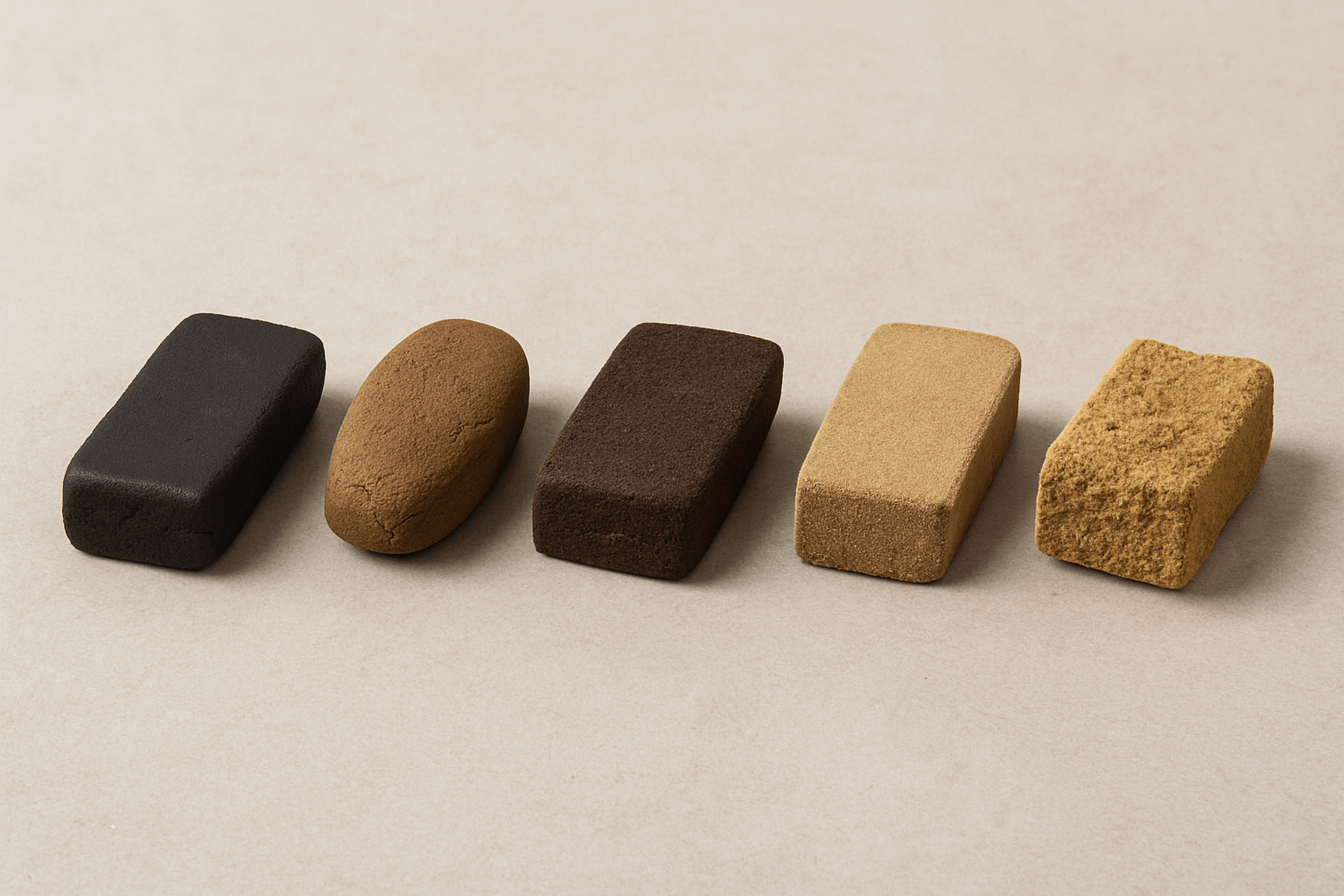
The Most Potent CBD Hash in Switzerland: The Complete Guide
Searching for “the most potent CBD hash in Switzerland” means asking a badly framed question. Potency covers three different and often contradictory realities, and the number printed on the label is paradoxically the weakest of the three indicators.
This guide explains how to actually read a percentage, why the extraction method sets a hard ceiling on purity, what the science genuinely establishes about the entourage effect in 2026, and why a product labelled 80 % CBD can deliver less effect than one at 45 %.
Important: the information provided here is general in nature and does not constitute medical advice. For any therapeutic use, consult a healthcare professional.
Key takeaways
- Switzerland permits hemp whose total THC content stays below 1 %, compared with 0.3 % in the European Union 1 2.
- An honest percentage is read as total CBD, calculated with the formula total CBD = CBD + (CBDA × 0.877), not from decarboxylated CBD alone.
- Above roughly 60 % CBD, a hash is no longer a pure resin: it has been enriched with isolate or distillate.
- The purest hash obtainable by mechanical means is currently static sift, whose purity advantage is documented in the peer reviewed literature 3.
- Bioavailability changes everything: around 31 % by inhalation versus 5 to 19 % orally 4.
- The entourage effect remains a plausible but unproven hypothesis, as recent systematic reviews state explicitly 5 6.
1. The three competing definitions of “potency”
Before comparing products, you need to know what is being measured. Three definitions coexist, and sellers happily exploit the confusion between them.
1.1 Cannabinoid concentration
The literal definition: how many milligrams of CBD per gram of product. It is objective, verifiable in a laboratory, and it is the only one that appears on labels. It is also the easiest to inflate artificially, as we will see.
1.2 Spectrum richness
A hash contains dozens of molecules: secondary cannabinoids (CBG, CBC, CBN), terpenes, flavonoids. Two products both showing 45 % CBD can have completely different profiles. This definition matches what enthusiasts call quality, but it is far harder to quantify.
1.3 The effect actually felt
This is what matters to the consumer, and it is the definition least correlated with the label. It depends on the consumption method, the dose actually absorbed, individual physiology and tolerance. A highly concentrated product used badly delivers less CBD to the bloodstream than an average product used well.
The point: these three definitions do not overlap. Any ranking of “the most potent hash” that fails to state which one it uses carries no information.
2. Reading a percentage correctly: the total CBD calculation
This is the point almost every competing article omits, and it is the most useful one in practice.
2.1 CBD and CBDA are not the same molecule
In the living plant, cannabidiol barely exists in its active form. It is present as an acid, cannabidiolic acid or CBDA. Heat triggers decarboxylation: the molecule loses a carboxyl group as CO₂ and becomes active CBD.
A serious certificate of analysis therefore shows two separate lines: CBD and CBDA.
2.2 The formula and where 0.877 comes from
To know a product’s real potential once heated, apply:
Total CBD = CBD + (CBDA × 0.877)
The 0.877 factor is not an arbitrary convention. It reflects the ratio of molecular weights: by shedding its CO₂, a CBDA molecule loses about 12.3 % of its mass. One gram of pure CBDA can therefore release only 0.877 grams of CBD 7. The same factor applies to THCA, CBGA and any cannabinoid with an equivalent molecular formula.
2.3 A worked example
Take two certificates of analysis:
| Product | CBD | CBDA | Real total CBD |
|---|---|---|---|
| Hash A | 48.0 % | 2.0 % | 48.0 + (2.0 × 0.877) = 49.8 % |
| Hash B | 12.0 % | 41.0 % | 12.0 + (41.0 × 0.877) = 48.0 % |
Hash B shows 12 % CBD on a naive reading, yet delivers almost as much as hash A once heated. An unscrupulous seller can display whichever figure suits them, in either direction.
2.4 The same calculation decides legality
This point is critical in Switzerland. The regulatory threshold applies to total THC, meaning THC + (THCA × 0.877), not to free THC alone. A product showing 0.4 % THC and 0.9 % THCA actually carries a total THC of 0.4 + 0.79 = 1.19 %, which pushes it outside the legal framework.
3. Swiss law and what it actually allows
3.1 Where the 1 % threshold really sits
The Federal Act on Narcotics (NarcA, SR 812.121) sets the general framework 2. The numerical value itself is fixed by the FDHA Ordinance on the Lists of Narcotics (SR 812.121.11), which defines controlled cannabis as cannabis whose total THC content reaches or exceeds 1.0 % 8. Below that threshold, the product falls outside the narcotics regime.
This distinction matters: it is frequently claimed that the threshold appears in the Narcotics Act itself, when it actually sits in the implementing ordinance.
3.2 European comparison
| Territory | Total THC threshold | Practical consequence |
|---|---|---|
| Switzerland | < 1.0 % | Broad cannabinoid profile, rich full spectrum resins |
| European Union (agricultural hemp) | 0.3 % | More constrained varietal selection |
| France | 0.3 % | Restrictive framework for flowers and resins |
| Italy | 0.2 % to 0.6 % depending on use | Historically a grey area |
The Swiss threshold, roughly three times more permissive, allows varieties with a more complete chemical profile. That is the real structural advantage of the Swiss market, independent of any marketing claim.
3.3 Product status and taxation
CBD resins and flowers intended for smoking are treated as tobacco substitutes. On that front, a February 2020 Federal Supreme Court decision ruled unlawful the 25 % tobacco tax that had been levied on CBD flowers, which reshaped the sector’s economics.
Swissmedic also publishes an enforcement aid detailing the boundary between consumer product, foodstuff, cosmetic and medicine 9. It is the reference document for understanding what a seller is allowed to claim.
3.4 A warning worth more than any percentage
Swiss legality does not travel. Crossing a border with CBD hash, even fully compliant with Swiss law, is an offence in most neighbouring countries, where thresholds are lower and resin is often treated separately from flower. No CBD percentage protects against a customs procedure.
4. Production methods set the purity ceiling
This is where the real hierarchy lies. The extraction method determines what a product can reach without additives.
4.1 Dry sifting (dry sift, pollen)
Dried plant material is rubbed across calibrated screens. Trichome heads, being denser, pass through the mesh. Particle size decides quality: fractions between 90 and 120 microns concentrate intact trichome heads, while finer meshes let more plant debris through.
Typical yield sits around 5 to 10 % of starting weight. According to published data, first pass purity from sieving alone plateaus around 40 to 50 %, rising to 50 to 60 % with a trommel screen 3.
4.2 Ice water extraction (bubble hash, ice-o-lator)
Plant material is agitated in ice water. The cold makes trichomes brittle, they detach and are collected across a series of filter bags. Yields exceed dry sifting, often 15 to 20 % on fresh frozen material, with a cleaner melt on combustion.
4.3 Static sift, the mechanical state of the art
Static sift is not a standalone extraction method but a refining step applied to dry sift. It exploits the fact that plant biomass and trichome heads take on opposite electrical charges.
This is the best documented point scientifically. A 2025 study published in the Journal of Cannabis Research measured plant biomass carrying a positive charge while trichome rich samples carried a negative charge of 20 to 100 pC. Combining mechanical sieving with electrostatic separation, the authors report 80 to 95 % round trichome purity on the first pass, and up to 99.8 % after multiple cycles 3.
These figures describe trichome purity rather than CBD content directly, but they explain why a well executed static sift sits at the top of the natural resin range.
4.4 Rosin
Pressure and moderate heat applied to flower, dry sift or bubble hash. Solventless. Pressing quality bubble hash yields more than pressing dry sift, which in turn yields more than pressing flower.
4.5 Enriched products, and why they are no longer hash
Beyond roughly 60 %, plant chemistry imposes its limits. To display 70, 80 or 90 %, something must be added:
- Ice rocks, moon rocks, meteorite: a flower or resin is coated in a concentrated extract then rolled in pollen. The percentage climbs, but the product is a composite.
- Isolate enriched resin: crystalline CBD isolate, over 98 % pure, is blended into a mid grade resin. The number rises, the terpene profile thins out.
- Pure extracts (wax, crumble, diamonds): at 85 to 99 %, these are no longer hash but concentrates, intended for different use and different equipment.
4.6 Summary table
| Method | Principle | Realistic total CBD | Typical purity |
|---|---|---|---|
| Pollen / dry sift | Dry mechanical sieving | 20 to 35 % | 40 to 60 % |
| Bubble hash | Ice water and filter bags | 30 to 50 % | 60 to 80 % |
| Static sift | Dry sift refined electrostatically | 40 to 60 % | 80 to 99 % |
| Hash rosin | Pressure and heat | 45 to 65 % | Variable |
| Enriched products | Resin plus added extract | 70 to 85 % | Composite |
| Pure extracts | Isolate, distillate | 85 to 99 % | No longer hash |
5. Why a high percentage does not guarantee a strong effect
One gram of hash at 80 % contains 800 mg of CBD. That does not mean 800 mg will reach your bloodstream.
The reference systematic review on CBD pharmacokinetics in humans establishes bioavailability of around 31 % when smoked, while available data place the oral route between 5 and 19 % 4. The difference comes down to hepatic first pass metabolism: a large share of a swallowed dose is metabolised by the liver before reaching systemic circulation.
| Route | Indicative bioavailability | Onset | Note |
|---|---|---|---|
| Inhalation | around 31 % | 5 to 10 minutes | Fast peak, shorter duration |
| Sublingual | 13 to 35 % | 15 to 45 minutes | Depends on contact time |
| Oral (ingestion) | 5 to 19 % | 60 to 120 minutes | Heavy hepatic first pass |
Direct consequence: a 45 % hash properly vaporised delivers more CBD than an 80 % product folded into a poorly dosed recipe. Consumption method outweighs ten percentage points on the label.
6. The entourage effect: what the science actually says in 2026
This is the argument most used to sell full spectrum hash, and the one that warrants the most caution.
6.1 The original hypothesis
In 2011, Ethan Russo proposed in the British Journal of Pharmacology the hypothesis of a synergy between cannabinoids and terpenoids capable of modulating therapeutic effects 10. The paper is foundational and heavily cited.
6.2 What recent reviews conclude
A cited hypothesis is not a demonstrated one. Two recent works are explicit:
- A comprehensive review published in 2024 in Pharmaceuticals, conducted under the PRISMA methodology, concludes that to date no reliable scientific evidence of this synergy exists, at least at the cannabinoid receptor level 5. The authors also note that the poor bioavailability and short half life of most terpenes make reaching active concentrations unlikely.
- A 2023 scoping review in Biomedicines reaches a comparable verdict: sound evidence supporting the entourage effect as claimed is lacking 6.
6.3 How to read this honestly
Absence of evidence is not evidence of absence. Terpenes have documented effects of their own at an exploratory level, and a product’s composition undeniably shapes its aroma, taste and subjective experience. But presenting the entourage effect as an established fact that justifies a price premium is a commercial argument, not a scientific finding.
A defensible position: choose a full spectrum product for its aromatic richness and minimal processing, without expecting a demonstrated pharmacological amplification.
7. Verify before buying: reading the certificate of analysis
A claimed percentage without a certificate of analysis is nothing more than a marketing statement. Here is what a serious COA must include.
- An identified, accredited laboratory, ideally to ISO/IEC 17025.
- A batch number matching the one on the packaging of the product you are buying. A generic COA covering every batch is worthless.
- An analysis date that is recent and consistent with the production date.
- CBD, CBDA and the calculated total CBD, plus THC, THCA and total THC.
- The terpene profile, if it is part of the sales pitch.
- Contaminant testing: pesticides, heavy metals, residual solvents, microbiology.
- The analytical method, typically HPLC for cannabinoids.
Red flags
- A CBD content above 60 % presented as a “100 % natural” resin.
- A COA with no batch number, no laboratory letterhead, or supplied as a low resolution image.
- No total THC calculation, or only free THC displayed.
- A label percentage that does not match the certificate.
- No contaminant testing, even though resins also concentrate residues.
8. Choosing for your use case
| Your goal | Recommendation | Why |
|---|---|---|
| Trying CBD hash for the first time | Pollen or dry sift, 20 to 30 % | Gradual dosing, controlled cost |
| Seeking aromatic quality | Static sift or bubble hash, 40 to 55 % | Best purity to terpene ratio |
| Seeking maximum resin potency | Premium static sift, 55 to 60 % | Realistic ceiling without additives |
| Seeking raw concentration | Pure extracts, 85 % and above | Requires specific equipment |
| Culinary use | Prioritise dosing, not percentage | Low oral bioavailability |
9. Safety and sensible use
- Driving: legal CBD hash contains up to 1 % THC. Swiss roadside tests detect THC, and recent consumption can produce a positive screen. Do not drive after consuming.
- Drug interactions: CBD inhibits certain cytochrome P450 isoenzymes involved in metabolising many medicines. Medical advice is necessary if you are on treatment.
- Pregnancy and breastfeeding: consumption is not advised.
- Dosing: start low and increase gradually, allowing for the onset time specific to each route of administration.
Frequently asked questions
What is the highest CBD content possible in a genuine hash? Without added isolate or distillate, a well made resin plateaus around 55 to 60 % total CBD. Above that, the product has been enriched.
Is an 80 % hash necessarily poor quality? No, but it is not a pure resin. It is a composite whose high percentage comes from an added extract. The questions to ask concern the terpene profile and the quality of the base material.
Why does my 50 % hash feel weaker than another at 40 %? Three main explanations: consumption method and therefore bioavailability, differences in secondary cannabinoids and terpenes, and individual tolerance.
Are total CBD and CBD content the same thing? No. Total CBD incorporates the undecarboxylated acid fraction via CBD + (CBDA × 0.877). It is the only figure comparable across products.
Is Swiss CBD hash stronger than European CBD hash? The Swiss threshold of 1 % total THC, against 0.3 % in the European Union, allows broader cannabinoid profiles. That does not automatically mean a higher CBD percentage, but a different composition.
Can I travel with CBD hash bought legally in Switzerland? No. Compliance with Swiss law does not extend beyond the border. Most neighbouring countries apply a lower threshold and treat resins specifically.
How can I tell if a percentage has been inflated with isolate? A figure above 60 %, a thin or absent terpene profile on the certificate, an unusually uniform texture and a neutral taste are converging indicators.
Does the entourage effect justify paying more? Recent systematic reviews do not confirm this synergy at receptor level. A full spectrum product is justified by its aromatic richness and low degree of processing, not by a proven amplification.
Conclusion
The most potent CBD hash in Switzerland is not the one showing the biggest number. It is the one whose total CBD is verified by an accredited laboratory on the exact batch you are buying, whose production method is consistent with the claimed percentage, and whose consumption method lets you actually absorb what you paid for.
In practice, a resin produced by static sift or ice water extraction, sitting between 45 and 60 % total CBD and backed by a complete certificate of analysis, represents the best compromise between concentration, purity and aromatic richness. Products advertised at 80 % and above belong to a different category, that of composites and concentrates, which serve a different purpose.
Sources
Footnotes
-
Federal Office of Public Health (FOPH). “Cannabis”. https://www.bag.admin.ch/en/addiction-and-health-cannabis ↩
-
Swiss Confederation. Federal Act on Narcotics and Psychotropic Substances (NarcA), SR 812.121. https://www.fedlex.admin.ch/eli/cc/1952/241_241_245/en ↩ ↩2
-
MacGowan C., Martynenko A. “Electrostatic separator of cannabis trichomes: an innovative approach to extraction”, Journal of Cannabis Research, 2025. DOI: 10.1186/s42238-025-00281-z. https://doi.org/10.1186/s42238-025-00281-z ↩ ↩2 ↩3
-
Millar S. A., Stone N. L., Yates A. S., O’Sullivan S. E. “A Systematic Review on the Pharmacokinetics of Cannabidiol in Humans”, Frontiers in Pharmacology, 2018, vol. 9, article 1365. https://pubmed.ncbi.nlm.nih.gov/30534073/ ↩ ↩2
-
André R., Gomes A. P., Pereira-Leite C., Marques-da-Costa A., Monteiro Rodrigues L., Sassano M., Rijo P., Costa M. C. “The Entourage Effect in Cannabis Medicinal Products: A Comprehensive Review”, Pharmaceuticals, 2024, vol. 17, no. 11, article 1543. DOI: 10.3390/ph17111543. https://pubmed.ncbi.nlm.nih.gov/39598452/ ↩ ↩2
-
“Decoding the Postulated Entourage Effect of Medicinal Cannabis: What It Is and What It Isn’t”, Biomedicines, 2023, vol. 11, no. 8, article 2323. DOI: 10.3390/biomedicines11082323. https://doi.org/10.3390/biomedicines11082323 ↩ ↩2
-
Fundación CANNA. “Quantification of the concentration of THC, CBD, CBG, THCA, CBDA, CBGA and total values by HPLC”. https://www.fundacion-canna.es/en/quantification-concentration-thc ↩
-
Swiss Confederation. FDHA Ordinance on the Lists of Narcotics, Psychotropic Substances, Precursors and Chemicals Used as Adjuvants, SR 812.121.11. https://www.fedlex.admin.ch/eli/cc/2011/363/en ↩
-
Swissmedic. “Products containing cannabidiol (CBD): overview and enforcement aid”. https://www.swissmedic.ch/dam/swissmedic/de/dokumente/marktueberwachung/abrenzungsfragen/produkte_mit_cannabidiolcbdueberblickundvollzugshilfe.pdf.download.pdf/produkte_mit_cannabidiolcbdueberblickundvollzugshilfe.pdf ↩
-
Russo E. B. “Taming THC: potential cannabis synergy and phytocannabinoid-terpenoid entourage effects”, British Journal of Pharmacology, 2011, vol. 163, no. 7. https://pubmed.ncbi.nlm.nih.gov/21749363/ ↩