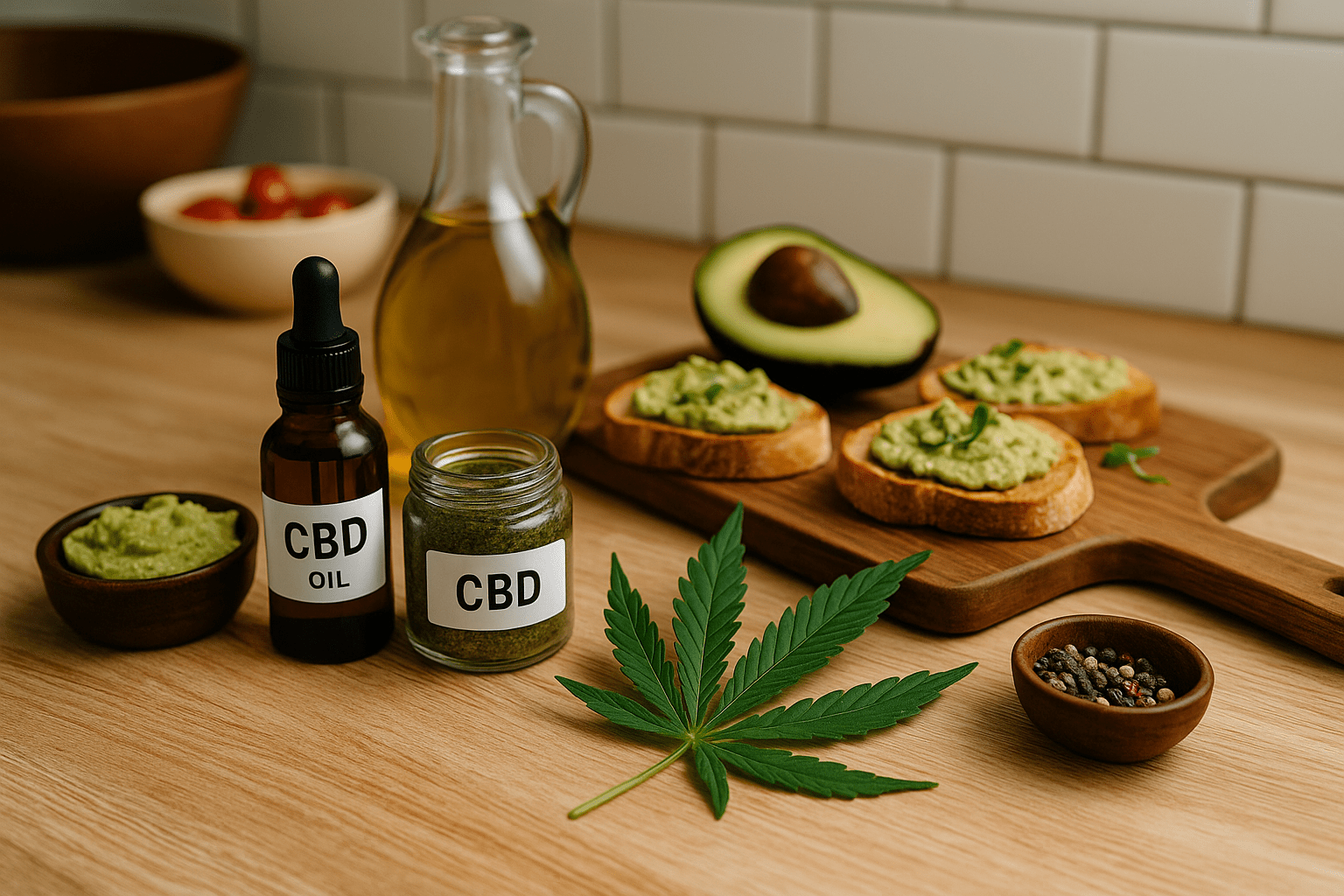
Express Appetizers: 5 CBD Hash Recipes Ready in 10 Minutes
Most CBD hash recipe articles skip two points that actually determine the outcome: what Swiss food law really says, and the fact that a cold recipe delivers almost no CBD at all.
This guide fixes both blind spots, gives the dose calculation method nobody spells out, then offers five preparations you can make in ten minutes.
Important: the information provided here is general in nature and does not constitute medical advice. For any therapeutic use, consult a healthcare professional.
Read this before cooking: the food status of CBD in Switzerland
This is the most frequently omitted point, and it is decisive.
Cannabinoids are “novel foods”
Under Swiss law, cannabinoids derived from hemp, CBD included, are classified as novel foods, since no significant food consumption in Switzerland or the European Union can be documented before 15 May 1997. As such, they can only be placed on the market with authorisation from the Federal Food Safety and Veterinary Office (FSVO) or the European Commission 1.
The FSVO states that to date no authorisation has been granted for hemp extracts containing cannabinoids, neither in Switzerland nor in the European Union. Foods with added CBD found on the market are therefore not compliant with food law 1 2.
What this changes in practice
| Situation | Status |
|---|---|
| Selling a CBD food preparation | Non-compliant without FSVO authorisation |
| Serving such preparations commercially | Non-compliant |
| Preparing at home for your own consumption | Outside the scope of placing on the market |
Novel food rules target placing on the market, not private home preparation. The recipes below are therefore intended for private use. Do not sell them and do not serve them in a professional setting.
This is a nuance most articles flatten by simply writing “it is legal in Switzerland”. The accurate wording is narrower.
The hash itself still falls under the THC threshold
Independently of food law, the resin must respect the 1 % total THC limit, calculated as THC + (THCA × 0.877). We cover that calculation in our guide to CBD hash potency.
Why a cold recipe delivers almost no CBD
Here is the second blind spot, and it is technical.
In unheated hash, cannabidiol sits in acid form
In the plant and in unprocessed resin, cannabidiol is present mostly as cannabidiolic acid, CBDA. Heat is required to convert CBDA into active CBD, through decarboxylation.
A kinetics study published in 2023 in the Journal of Plant Biochemistry and Biotechnology heated hemp samples at 100, 110, 120, 130 and 140 °C for 180 minutes, sampling every 20 minutes with HPLC quantification. The authors observe an exponential decline in CBDA alongside rising CBD, then CBD degradation beyond a certain point. The optimal conditions reported are 140 °C for 30 minutes 3.
The practical consequence for appetizers
An avocado spread, skewers or tzatziki never get hot. Hash stirred in raw therefore stays essentially as CBDA.
| Preparation | What you actually ingest |
|---|---|
| Cold recipe, raw hash | Mostly CBDA |
| Hash decarboxylated first, then added cold | Mostly CBD |
| Recipe cooked above 100 °C | Partial conversion during cooking |
CBDA is not inert and is the subject of research, but it is not the same molecule as CBD. Announcing a dose “of CBD” in a cold recipe using raw hash is therefore inaccurate.
How to decarboxylate before adding
If you want CBD rather than CBDA:
- Crumble the resin finely onto a tray lined with baking paper.
- Bake at 110 to 120 °C for 30 to 45 minutes, covered to limit terpene loss.
- Let it cool before incorporating.
This window, lower than the 140 °C optimum, preserves aroma better at the cost of a slightly longer time. See our detailed article on CBDA to CBD conversion kinetics.
Calculating your dose properly
Recipes that say “two pinches” without further detail allow no control at all. Here is the method.
The formula
mg of cannabinoid in the recipe = hash weight in mg × percentage
Then divide by the number of servings.
A worked example
Take 0.2 g of hash testing at 45 % total CBD, for a recipe serving 4:
- 200 mg × 0.45 = 90 mg of cannabinoids for the whole recipe
- 90 ÷ 4 = 22.5 mg per serving
The “pinch” trap
A pinch of crumbled resin weighs in practice between 0.05 and 0.15 g. Two pinches therefore easily represent 0.1 to 0.3 g, meaning 45 to 135 mg of cannabinoids with a 45 % resin. Articles claiming “3 to 5 mg per serving for two pinches” are off by an order of magnitude. Weigh, do not guess.
Bioavailability changes the calculation again
Taken orally, CBD undergoes substantial hepatic first pass metabolism. The reference systematic review places oral bioavailability between 5 and 19 %, against around 31 % when smoked 4.
Of the 22.5 mg in our example, the fraction actually reaching circulation therefore sits around 1 to 4 mg. This is why useful oral doses are markedly higher than inhaled ones.
| Hash used | Percentage | Recipe total | Per serving (4) | Estimated absorbed |
|---|---|---|---|---|
| 0.1 g | 30 % | 30 mg | 7.5 mg | 0.4 to 1.4 mg |
| 0.2 g | 45 % | 90 mg | 22.5 mg | 1.1 to 4.3 mg |
| 0.3 g | 50 % | 150 mg | 37.5 mg | 1.9 to 7.1 mg |
Recommendation: for a first attempt, aim for 10 to 20 mg per serving and tell your guests the dose.
The five recipes
Each recipe serves 4, with a starting dose of 0.15 g of 45 % hash, roughly 17 mg per serving. Adjust to your own product.
1. Avocado spread with CBD hash
Ingredients: 1 ripe avocado, juice of half a lemon, 1 tablespoon olive oil, 0.15 g finely crumbled hash, salt, pepper, fresh coriander optional.
Method (10 min)
- Mash the avocado flesh with a fork.
- Stir in lemon juice, salt and pepper.
- Mix the hash into the olive oil first and work it for a minute. Cannabinoids are lipophilic: without fat, dispersion is uneven and per serving dosing becomes a lottery.
- Fold the infused oil into the avocado and mix thoroughly.
Note: cold recipe, therefore mostly CBDA unless the hash was decarboxylated beforehand.
2. Tomato and mozzarella skewers
Ingredients: 12 mozzarella pearls, 12 cherry tomatoes, fresh basil, 2 tablespoons extra virgin olive oil, 0.15 g crumbled hash, salt, pepper.
Method (10 min)
- Combine oil, hash, salt and pepper. Let infuse 5 minutes, stirring.
- Assemble the skewers: tomato, mozzarella, basil.
- Drizzle with the infused oil just before serving.
Dosing tip: the oil settles at the bottom. Spoon it out rather than pouring, otherwise the last skewers concentrate the dose.
3. Cream cheese and pepper crackers
Ingredients: 8 to 12 crackers, 100 g cream cheese, half a red pepper, 0.15 g hash, chives, salt, pepper.
Method (10 min)
- Whip the cream cheese vigorously with the crumbled hash. The cheese fat acts as the carrier.
- Season, spread, top with diced pepper and herbs.
Watch out: count the exact number of crackers to know the unit dose. Twelve crackers for 0.15 g at 45 % gives roughly 5.6 mg each.
4. Vegetarian mini sandwiches
Ingredients: 4 slices wholemeal bread, 2 tablespoons pesto, half a cucumber, 4 tomato slices, 0.15 g hash, olive oil, salt, pepper.
Method (10 min)
- Mix the pesto with the crumbled hash. Pesto, already oily, is an excellent carrier.
- Spread, layer cucumber and tomato, close and cut into triangles.
5. Tzatziki verrines
Ingredients: 200 g Greek yoghurt, half a cucumber grated and drained, 1 garlic clove, 1 tablespoon olive oil, 0.15 g hash, salt, pepper.
Method (10 min)
- Drain the grated cucumber so the mixture does not turn watery.
- Mix the hash into the olive oil before folding it into the yoghurt.
- Add garlic, cucumber, salt and pepper. Portion into small glasses.
Note: full fat Greek yoghurt disperses better than a low fat version.
Temperatures: what to respect
If you adapt these recipes to hot preparations, two limits stack up.
| Compound | Thermal marker | Effect of exceeding it |
|---|---|---|
| Light terpenes (myrcene, limonene) | volatilise from 150 to 170 °C | Loss of aroma |
| CBD | progressive degradation beyond 140 to 160 °C depending on duration | Loss of content 3 |
In practice, stay below 160 °C and avoid long high temperature cooking. Infusing into a fat over low heat, around 90 to 110 °C, preserves more.
Onset time: the most common mistake
Taken orally, effects do not appear before 60 to 120 minutes, against 5 to 10 minutes by inhalation 4.
The classic mistake is to feel nothing after thirty minutes, take another serving, then have both doses arrive together. Serve, then wait at least two hours before considering a second portion.
Safety and courtesy
- Tell your guests. Serving a preparation containing cannabinoids without saying so raises an obvious consent problem, and can be an issue for anyone on medication, pregnant, or planning to drive.
- Driving: Swiss law sets a limit of 1.5 micrograms of THC per litre of blood, with zero tolerance. Since legal CBD hash contains up to 1 % THC, nobody should drive after consuming.
- Drug interactions: CBD inhibits certain cytochrome P450 isoenzymes involved in metabolising many medicines. Medical advice is necessary if you are on treatment.
- Pregnancy and breastfeeding: avoid.
- Storage: away from light, heat and humidity. Preparations using fresh produce should be eaten the same day.
Frequently asked questions
Can I sell these preparations at an event? No. Foods with added cannabinoids do not comply with Swiss food law without novel food authorisation, and none has been granted to date 1.
Do I need to decarboxylate the hash for these recipes? It depends what you want. Without decarboxylation you ingest essentially CBDA. With prior decarboxylation at 110 to 120 °C, you get CBD.
Why always mix the hash into a fat? Cannabinoids are lipophilic and barely soluble in water. Without lipids they distribute poorly and the dose varies sharply between servings.
Can I use CBD oil instead? Yes, and it is easier to dose since the content is stated in mg per millilitre. The food status remarks still apply.
Can these recipes cause a positive drug test? Yes, it is possible. Swiss CBD hash contains THC, and products containing THC have produced confirmed positive urine results in controlled studies. See our CBD hash myths.
How long do the effects last? Orally, longer than by inhalation, typically several hours, with a slow onset.
Conclusion
A successful CBD hash apéro comes down to three things most recipes ignore: knowing that novel food rules confine these preparations to private use, understanding that a cold recipe delivers CBDA rather than CBD, and weighing your resin instead of counting pinches.
The rest is ordinary cooking: a fat to disperse, careful mixing to homogenise, and patience before serving seconds.
Sources
Footnotes
-
Federal Food Safety and Veterinary Office (FSVO). “Cannabis, hemp extracts and cannabinoids as food”. https://www.blv.admin.ch/blv/en/home/lebensmittel-und-ernaehrung/rechts-und-vollzugsgrundlagen/bewilligung-und-meldung/bewilligung/cannabis-cannabidiol.html ↩ ↩2 ↩3
-
Swiss Confederation. Ordinance on Foodstuffs and Utility Articles (FUAO), SR 817.02. https://www.fedlex.admin.ch/eli/cc/2017/63/en ↩
-
Fućak T., Kreft S., Svedružić Ž. M., Tavčar E. “Mechanism and kinetics of CBDA decarboxylation into CBD in hemp”, Journal of Plant Biochemistry and Biotechnology, 2023, vol. 32, pp. 608 to 621. https://doi.org/10.1007/s13562-023-00847-z ↩ ↩2
-
Millar S. A., Stone N. L., Yates A. S., O’Sullivan S. E. “A Systematic Review on the Pharmacokinetics of Cannabidiol in Humans”, Frontiers in Pharmacology, 2018, vol. 9, article 1365. https://pubmed.ncbi.nlm.nih.gov/30534073/ ↩ ↩2